
👋 Hi Carina and Daniel. Thanks for subscribing to Future Community. Great to have you along for the ride.
Expertise fallacy
Last week I posted a short blurb linking to a piece about the results of the Future Community membership campaign I ran in September. That prompted a surprising number of messages and notes. We're talking several, not hundreds. But even one reply or comment can feel surprising (and appreciated and useful!).
What was interesting was the appreciation for sharing what worked AND what didn't. A lot of folks here are running everything from similar thought leadership type newsletters to full-blown newsletter businesses to large-scale organizational communications and fundraising programs.
Across all those cases (especially big programs) there's very little room for vulnerability. There's lots of chatter about testing and failing fast and learning. But for consultants paid for success and/or leaders running teams who have a million things to get done, there's really no incentive to take risks and maybe fail.
There's never space for saying "we didn't get this right." Everything is spun as a success so that we don't lose a job, a contract, a promotion, or even our self confidence.
All of this is a segue into talking about Newsletter Nerd, last week's Let's Build You a Newsletter workshop, and the relationship between community and learning.
Community is your consultant
I tend to be in the "community is your consultant" school of learning. I just made that up. Maybe it's a thing.
My goal with Newsletter Nerd Club is to create a space where comms people working on community and content strategy can talk with others, share experience, and ask questions.
Often, people in nonprofits and other organizations are tied to goals - money, clicks, follower count, stories posted - that have no relation to loyalty, learning, belonging, or community thriving.
Newsletter Nerd Club seeks to solve for that. They're the sorts of conversations that I missed for years and would love to see happening more often.
But ideas of consulting, expertise, and short-term value get in the way of running events where people can connect to each other.
Last week's workshop was built around a worksheet participants can use and fill out as we worked through the session. It's a facilitated guide to many of the central questions needed to plan, design and launch a newsletter project: goals, audience, content, cadence, and platforms.
That's simply too much for a 90-minute workshop. The tension is amplified by a format that gets people answering questions, offering input, and sharing with one another.
Future events could be shorter but focused on just one piece of the project. Even then you're scratching the surface and probably not giving people a chance to collaborate.
I believe it's possible to create a collaborative community space grounded in expertise. Perhaps the trick is to set aside the consulting-driven idea of delivering expertise and remember what most consultants know: it's not skill and capacity that organizations need, it's the collaborative spaces, curiosity, and trust needed to explore, try, sometimes fail, and always learn.
I'll let you know when we've built that.

Your email list contains multitudes
1440 is a daily newsletter with 4.5 million subscribers and $27 million revenue. A story by Kari McMahon at A Media Operator looks at how 1440 is "moving away from the inbox." Everyone, it seems, wants to grow up and become a platform where they can access more of the user's time and money.
The story is primarily about the mechanics of that shift. Moving an email only newsletter business with an ad-based revenue model onto content platforms outside the inbox is no small feat. Some may look at it as a signal that they're giving up on email or that email is fading.
I'd say it's a sign that email can work to build a loyal audience of users.
What's more interesting to me, though, is the user data driving the move. What the data shows is that subscribers are spending most of their time with content that isn't what brought them there.
That's a powerful idea for communicators and newsletter operators inside and outside organizations to hold onto.
“One of the strongest signals that we’ve seen again over the years with our primary readership is [for example] business people don’t open the Daily Digest for business news necessarily,” Steigerwald said. “They open it for science and tech news, and most of the time, they didn’t know that they were fascinated by something until we put it in front of them.”
The people on your email list are unique and weird individuals. Each of us contains multitudes. Right now, the nonprofit sector is talking about personalization, usually with AI, to optimize messaging to the unique interests of its supporters. Primarily as a way to create a false sense of connection and/or find the magic words that persuade that donor to give.
Drew Steigerwald, Chief Content Officer at 1440, doesn't think AI is good at content personalization. That's part of the motivation for driving people to a platform where more and more variety of content is available.
“It’s [AI] very powerful in a lot of different ways,” he said. “But mimicking the weirdness and the weird rabbit holes that the human brain goes down is not one yet.”
For us simple communicators and newsletter folk perhaps the takeaway I'll offer is that newsletters and other niche-ish content products offer a broader terrain than traditional email, blogs, and social posts for offering content that's unique, has a voice, goes deep into topics, or offers up quirky (or at least memorable) tidbits for your supporters.
Having all the facts and data and persuasiveness isn't the same as being interesting.
Bright Ideas ☀️
Smart people. Big questions.
1/ I want to say, and will, that more work on community building and belonging is fantastic to see. But putting so much money into "measuring" belonging's effectiveness instead of the simple work of it is such a modern nonprofit sector thing to do. Can belonging be measured? Nonprofits are betting millions it can. [Chronicle of Philanthropy]
2/ Measure this: Young people wanted community. They got 'eventslop.' by Kelsey Weekman with a featured appearance from a guy who goes by etomoloygynerd on TikTok. It's no wonder people aren't having dinner parties. They're not very algorithmic.
3/ Some of what's in We Have a Climate Imagination Problem [by Solitaire Townsend in Time] may not be your jam. They make a case that better, more hopeful, possible, and visionary stories are needed from climate advocates. And then some blame is put where it belongs: people with the imagination and power to tell stories are stuck implementing poor communications strategies instead of creating the magic they were trained to do. [that's my interpretation...your mileage may vary]
4/ How Defunding the Arts Wrought Civic Disintegration by Anna Kornbluh in Art in America. A look at the impact of public arts funding on the collective that is America as told through 1976 Bicentennial community arts projects. Thanks to Shannon Mattern for the link.
5/ In The Lure of Effective Altruism Madeline Ley describes working with students who say that they can't talk about ethics, morals, or good/bad/right/wrong in their tech jobs. This parallels the fallacy of expertise in consulting.
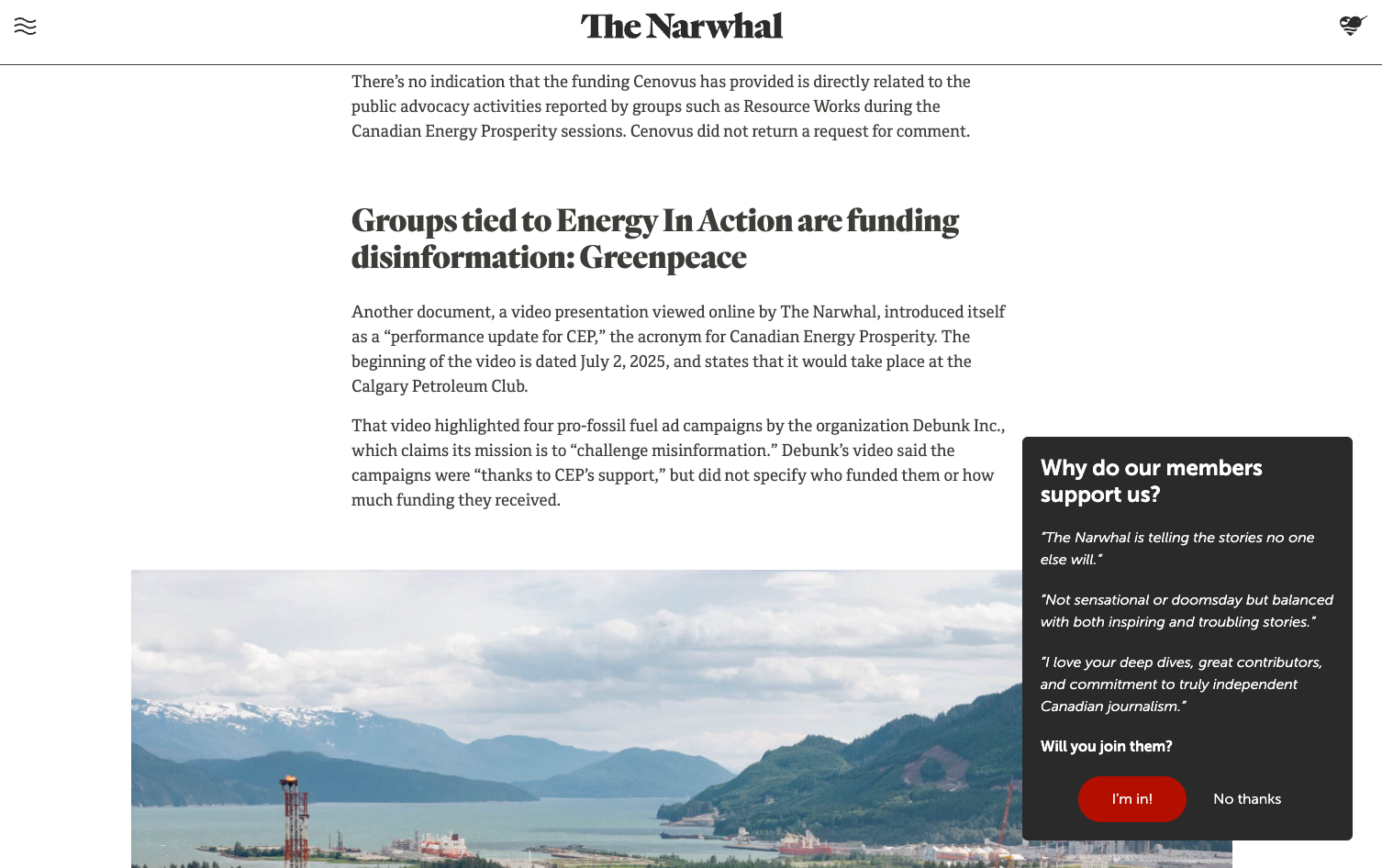
6/ Steal this: A small membership nudge popped up reading a story on The Narwhal. It slides in at the lower right of the page. It's obvious but not lightbox level overwhelming. The nudge highlights testimonials from members. One could put anything in here (and test it). Not hard to implement. Clever, especially for year end.
Events and Training
- Reflecting Back on 2026: Nonprofit Tech Success Stories & Lessons Learned - a free online event hosted by NTEN DC on October 29th.
Want to get your event or training out to the Future Community network? We're happy to share. Click reply and make sure we know about it.
Future Community Jobs
Juicy jobs incoming. Get a full list on Tuesday or check the always updated Future Community job list.
- Associate Executive Director : New Roots Institute [Remote] ⏱️ October 20
- Audience Engagement Manager : Investigate West [Remote in Idaho, Oregon, or Washington] ⏱️ October 22
- Chief Product Officer : The 19th [Remote in the US] ⏱️ October 19
- Director of Communications and Marketing : Carbon Mapper [Remote in the US]
- Vice President of Fundraising : Book Trust [Remote in the US]
Hi. I'm Ted Fickes. I run Bright+3 where we help teams in progressive spaces create content and stories that build community so that organizations turn supporters into leaders. I also write Future Community (this newsletter) and run Future Community Jobs.