

👋 Hello! Welcome to Future Community Nic, Kate, Bishara, Bianca and Colleen. A few of you have touched base already. To everyone, thanks for being here and please reach out to say hello, are chat about what you're working on.
This time around we have a few thoughts (and links) to share on AI content disclosure, the slow but sustainable work of turning stories into meaning and power, falling social traffic, climate narratives, the endless thirst of Silicon Valley's venture fascists, and so many good jobs for good people who want to do good work.
Wilderness Land Trust works across the western US to secure private property within designated wilderness areas and ensure its long-term protection. This half-time role for a proven major gifts fundraiser will be based in California or Colorado though remote candidates will be considered. Apply by May 1.
Slow power
Yesterday I shared a few disparate articles and conversations that look at the need relational infrastructure to transform the endless firehose of content into tangible action people can get behind. In other words, how do we help people transform the constant flow of search optimized content and news into sustainable change?
 Ted Fickes
And into the AI disclosure rabbit hole we go...
One of the biggest concerns nonprofit and news organizations have about AI is if and how it affects authenticity, credibility, and ultimately trust.
How are you thinking about AI content and trust? When does it make sense to let people know you're using AI to develop content? And what audiences do you tell?
The answer could simply be don't use AI to produce content. I'm not opposed to this. But is that realistic? It's like telling a math or engineering student they can only use an abacus. Or disabling spell check on everyone's computer.
AI is poorly defined. It is everything and nothing all at once. It's going to be used here and there in big and little ways. And you're likely going to be using to be using it to develop and/or manipulate data, images, words, and ideas.
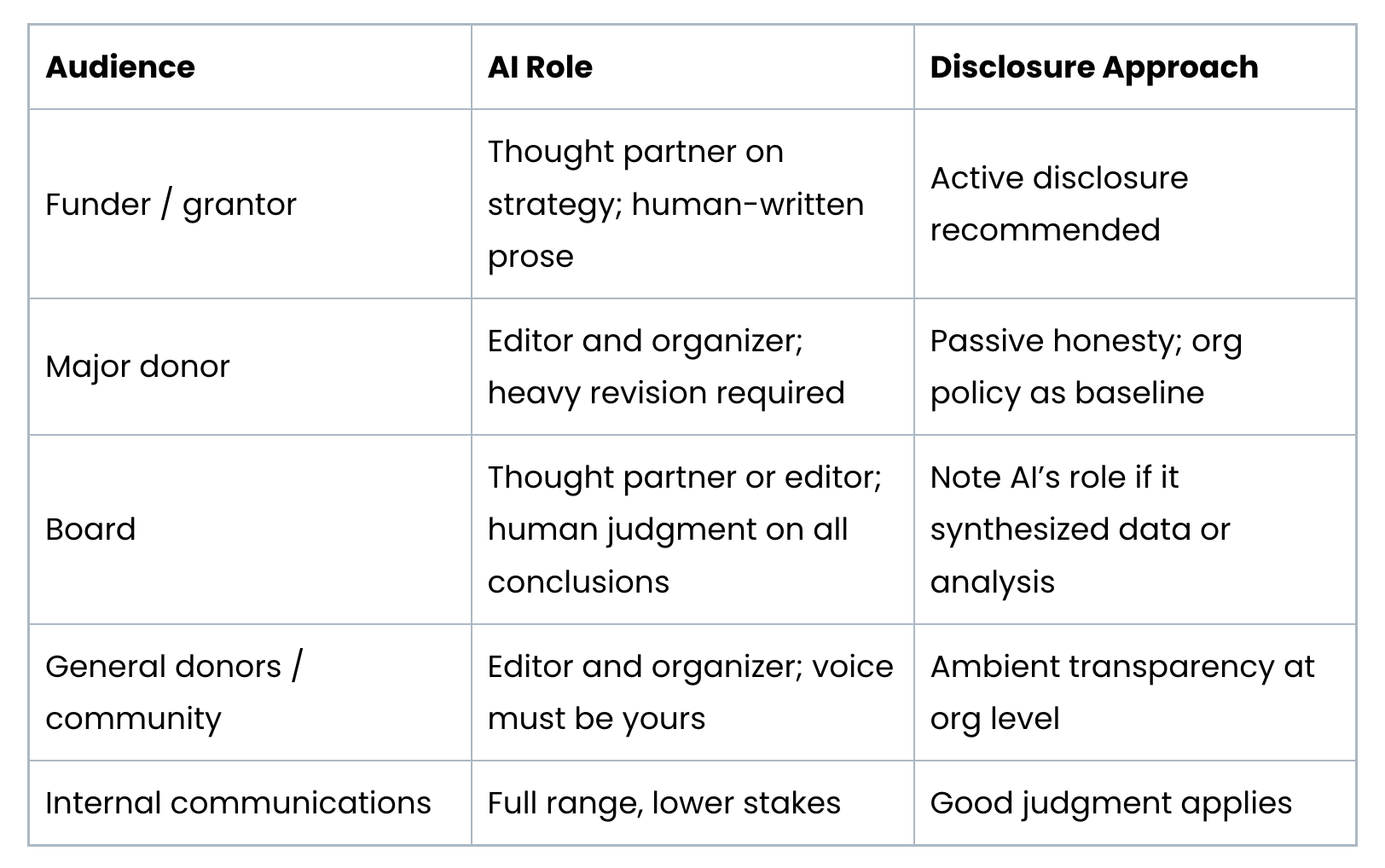
A lot of folks are thinking about this in the news, nonprofit, creator, and social content sectors. Sage Eubanks at Brevity and Wit put together a helpful framework for thinking about AI content transparency. Here's a screenshot of the table they use to summarize this but you should check out the full piece. There's useful thinking here about audience, content intent, and more.
Ryan Davis at People First offers an alternate take: any AI disclosure hurts trust. A recent AAPC (American Association of Political Consultants) study, The Disclaimer Effect, found that AI disclaimers are a cognitive speed bump and introduce questions and wariness. For those not using AI or deploying it in pretty minimal ways (an editing partner, perhaps) you may be creating unneeded concern, caution or fear.
I suspect the world of directly political content (candidate or issue) is particularly fraught on this front. Trust and political messaging are like oil and water. They don't naturally mix these days.
Ryan's advice is to avoid AI altogether and focus on trusted messengers - your own people and influencers who have established audience trust.
The solution is murky, of course. There's no one size fits all approach. AI is going to find its way into your content creation if it hasn't already. I'd suggest that you will benefit most from ongoing and thoughtful conversation about the role of technology in your communications more generally. To be frank, most organizations I know are exposed to far more risk from lax digital and CRM security than they'll ever be from AI use.
This is why I like the framework supplied by Brevity & Wit above. Don't just think about when and how to disclose AI. Consider if active use of AI is needed. And if and how disclosure would be relevant to the use, product, and audience.
Bright Ideas
- M+R's annual nonprofit benchmarks report is here. That warmth you feel is the energy of a thousand hot takes zooming around the nonprofit world. I'll offer some cold hard takes later.
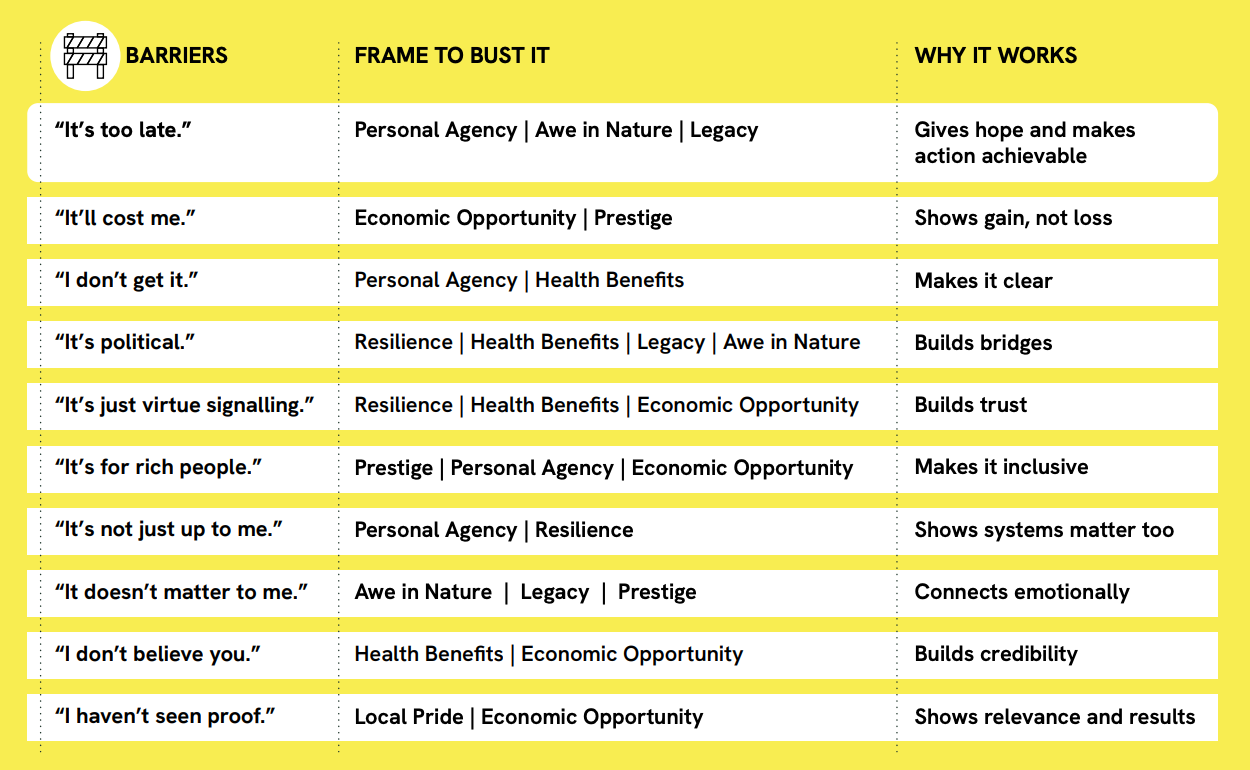
- Climate communicators may want to check out the Climate Narratives Toolkit from Futerra. There's a lot here. The clearly laid out framing of messages that challenge common objections to climate policy is especially useful.
- How storytelling can open the door to thriving futures is one piece in the wonderful Story Commons developed by Sheffield, UK, based Peoples Newsroom and Opus.
- This piece was mentioned in my Slow power article linked above but deserves another take: In Social traffic kinda stinks for news publishers now, in 3 charts, Laura Hazard Owen debriefs us on what Chartbeat data tells us about the crappy state of social platforms as traffic sources for news. I haven't seen similar data for nonprofits. It's wildly unlikely that nonprofit social traffic strategies are outperforming news. The concerns are different: nonprofits would like to drive traffic to their websites (donations!) but can lean harder into awareness and mobilization goals. But these goals are hard to measure. And the optimal outcome is that a social follower moves to an owned channel like email. That's not happening. [Nieman Lab]
- Sarah Alvarez, in her News Fix blog, writes about the need for a Much Slower System of news and content: "We need less news delivered more intentionally, even as the attention economy pushes in the other direction. We all know it." Yep.
- Peter Thiel's Objection.AI project may or may not go anywhere but it offers insight into the power over news (and advocacy) communications sought by Thiel and others in tech. [Nic Dawes / Coda]
- If you like that you may love this guide to Department of War contracting that A16Z has for tech startups. 🤮
- Measuring journalism's impact on civic discourse (and journalism's civic value). [Samantha Ragland and Kevin Loker / American Press Institute]
- Journalists aren’t the only ones sharing the news, and that’s a good thing explores how community news and storytelling is the work of many hands, including nonprofits. [Megan Lucero / The Objective]
- Don't ask AI, ask a peer is a new collaboration between Global Voices, the Association for Progressive Communication (APC), and GenderIT. The grounding question: What if, as well as affirming the value of human diversity and creativity, we demonstrated it in practice? I'm on board but also sad this needs to be a thing. [via Jed Miller]
- With The Bear is Still Watching Erin Eberle brings poetry into story of the Trump administration's dismantling of the US Forest Service and environmental health in general. Eberle references Gary Snyder's Smokey the Bear Sutra and reminds us that the battles of politics and power are not simply won with more data and information.
Snyder challenged us to see environmental degradation and social injustice as intertwined crises, and to understand resistance to industrial capitalism not only as political or economic struggle, but also as something spiritual — a path toward a more just, more sustainable way of being.
...
the antidote to the loveless knowledge Snyder named is not more information. It is the willingness to feel it — to let the reality of other lives, human and non-human alike, actually matter to us.
Tools
- Shout out to Bryan Vance for launching the Portland (Oregon) Farmers Market Directory as part of Stumptown Savings. Not just a useful gadget for Portland people, it's a good example of organizing info into a destination that can draw traffic and return visits (and loyalty!) from your audience.
Events
- Rights x Tech and Democracy Well are hosting an online conversation with V Spehar of Under the Desk News on May 6: Building Digital Community with Joy. Come by and fill your cup.
I'm committed to making Future Community, including job postings, free for everyone. There are a few ways you can help make that possible:
- Become a monthly or annual supporting member. Supporting members receive extras like one-on-one coaching or consulting, access to events, and more.
- Hiring? Feature your job listing and get it in front of wildly sharp nonprofit professionals. Submit your featured job here.
- Sponsor a week or two of Future Community. Get in touch to chat about how we could work together.
Future Community Jobs
Remember, the full Future Community job list is always on, always fresh and, unlike your orange juice, always safe from private equity and real estate speculators.
Audience, content, journalism and news roles
- Senior Correspondent, Investigations : WIRED [New York City]
- Chief Executive Officer : Nonprofit Quarterly (NPQ) [Remote in the US]
- Engagement Reporter : ProPublica [Remote in the US]
Communications
- Communications and Marketing Manger : Tactical Tech [Berlin] ⏱️ April 30
- Senior Communications and Donor Stewardship Manager : Pew Research Center [Washington, D.C.]
- Digital Communications Director : City of Boston [Boston]
- Communications Specialist : Spark Climate Solutions [Remote]
- Communications Coordinator - Make Big Polluters Pay Campaign : Oxfam Australia [Melbourne / Sydney / Remote in Australia] ⏱️ May 4
Nonprofit organizations
- Executive Director : Carbon Plan [Remote in the US] ⏱️ May 29
- Associate : Climate Innovation Fund [Washington, DC]
- Climate Surge Executive Director : Climate Solutions [Seattle, WA]
- Digital Marketing Associate : Peninsula Open Space Trust [Pablo Alto, CA]
- Digital Writer : The Institute for Middle East Understanding (IMEU) [Remote in the US]
- Executive Director: Pennsylvania Voice [Philadelphia, PA]
- Conservancy Data Specialist : Chesapeake Conservancy [Annapolis, Maryland]
- Community Organiser - Make Big Polluters Pay Campaign : Oxfam Australia [Melbourne / Sydney / Remote in Australia] ⏱️ May 4
- Director, Community Investment & Grantmaking : Yoga Alliance [Remote in the US] ⏱️ April 27
- Vice President, Government Affairs : National Parks Conservation Association (NPCA) [Washington, DC]
- Officer, Data and Policy, Courts & Communities : Pew Research Center [Washington, DC]
- Outreach Coordinator : REEF [Key Largo, Florida]
- Director of Government Relations : Public Lands Alliance (PLA) [Washington, DC]
Fundraising and Development
- ⭐ Director of Major Gifts : Wilderness Land Trust [Remote in California or Colorado preferred] ⏱️ May 1
- Donor Community Advisor : Movement Voter Project [Remote in the US]
- Director of Major Gifts and Digital Fundraising Specialist : Chesapeake Conservancy [Annapolis, Maryland]
- Director of Development and Marketing (application link here) : Aurora Public Schools Foundation [Aurora, CO]
- Digital Fundraising Associate : Morris Animal Foundation [Denver]
Foundations and Philanthropy
- Event Operations Manager : William and Flora Hewlett Foundation [Menlo Park, CA]
- Financial Operations and Compliance Director : Western Conservation Foundation [Denver]
- Director, Corporate and Foundation Relations : Social Current [Remote in the US]
Agencies, data, politics, products & more
- Head of Joint Actions (part-time / contract) : Civic Shout [Remote] ⏱️ April 28
- Executive Director : Justice Democrats [Remote in the US]
Hey. Ted here. I run Bright+3 where we give changemakers the ideas, inspiration, and tools to create content that builds stronger communities.
I also write this newsletter, Future Community, and run the Future Community Jobs list.
Thanks for being part of Future Community. Help make this work possible (and get some extra support) by becoming a supporting member.
Still here? I have a joyful bonus read for the cyclists and community builders out there. Don't say I never shared any Buffalo content.
 Buffalo Rising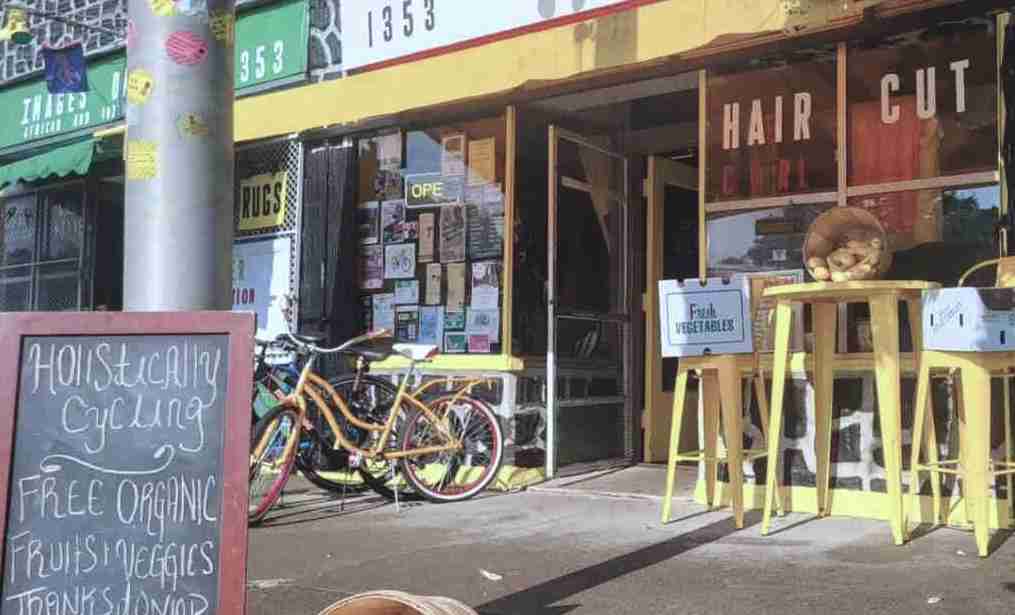
But we don’t really know where we are when the entire city is a place that we drive past at 60 miles per hour, or ignore in favor of scrolling on our phones. When we are separated from our communities in that way, it pushes us to define ourselves in opposition to our neighbors, to accept that our interests are not aligned with theirs, that it’s not worth investing in a neighborhood on the other side of the expressway, because when would you go there anyway?