
👋 Howdy! I want to shout out new folks round here: Welcome to Future Community Adam, Fata, Spencer, Phyllis, Yael, and Sam. Glad to have you. Reach out to say hello. I'd love to hear about what you're working on and how we can help.
🚨 Join me at Newsletter Nerd Club on May 12th. We'll be talking about newsletter superpowers: reach, relationship building, storytelling, revenue and more. We'll have time to talk with other newsletter creators, ask questions, and get ideas. Sign up and join your new best newsletter friends at noon Eastern on May 12th.
Dark days demand delight
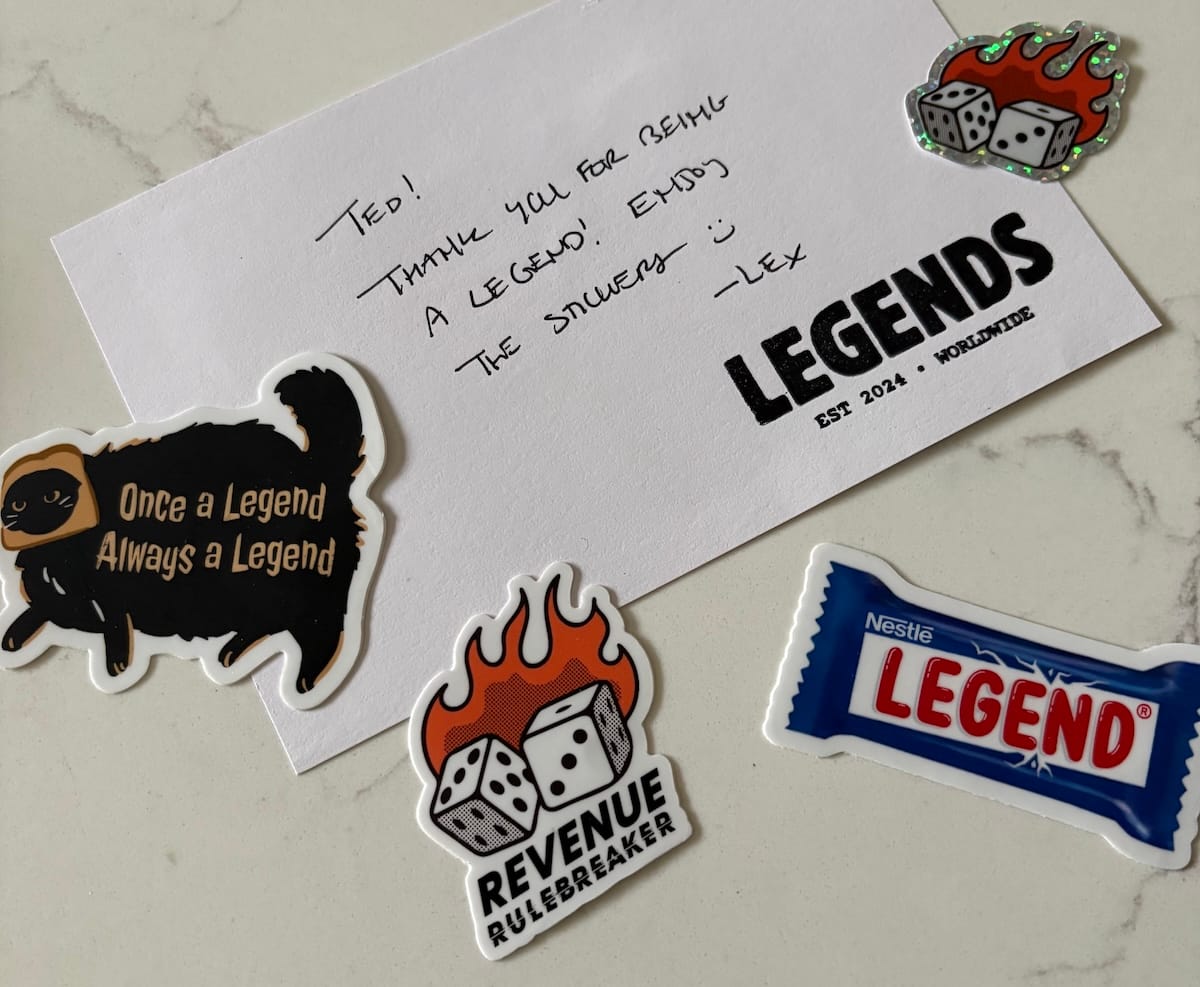
Do you make your people feel special and like they're a part of something unique? A colleague (I'm looking at you, Matt Kelley) likes to talk about surprise and delight. Here's a great example of that. Lex Roman runs the Legends program. It's a network of entrepreneurial creatives building newsletters and businesses by supporting each other. Last week the Legends starting receiving a sticker pack from Lex. Delightful!
On Unsubscribes
I'm seeing an uptick in people talking about unsubscribe rates, workflows, how to prevent unsubs, and more. I suspect it's because the nonstop noise of email is intersecting with the reality that it's getting hard (and more expensive) to grow an email list. That's my take, anyway.
In general, I tell list owners and comms folks not to overthink unsubscribe rates. Would you rather an email address (and the person on the end of it) unsubscribe or quietly ignore every email you send for the next five years? I'll take the former but lots of folks out there hold out hope in their inactive subscribers.
Around the nonprofit world folks will tell you that keeping unsubscribe rates under 0.2% for any particular email is a good goal. Email providers (Gmail, Hotmail, etc.) look at these rates, too.
Here are some snippets from recent M+R Benchmarks reports:
2026 Benchmarks
Overall, 4% of email subscribers at the start of the year became unreachable due to bounces, and an additional 12% were lost to unsubscribes. Disaster/International Aid nonprofits reported a 6% bounce rate, and a 21% unsubscribe rate.
2025 Benchmarks
An average 6.6% of email addresses on file on January 1, 2024 were lost due to bounces, and another 8.8% left via unsubscribes.
2024 Benchmarks (they were more loquacious that year)
Now, the descent: 15.7% of email subscribers were lost to churn over the course of 2023. That churn was divided between bounces (6.7%) and unsubscribes (8.7%). For Environmental nonprofits, average churn was 20.7%, and in the Rights sector average churn was 25.4%! That’s a long way to slide down!
There's an ebb and flow to unsubscribe rates. But they rose last year, at least according to M+R's benchmarks.
What matters to me more than the unsub rate of any particular email or year is WHO is unsubscribing. If you're seeing a growing number of donors and activists leave the list (and stop donating) you should check into it. Send people an email. Do a survey. Make some phone calls.
The reasons may have nothing to do with your emails. Could be deaths, economic factors, switching email addresses. Or it could be your emails are leaving people cold. Or that people are stepping back from email but following you elsewhere (or would like to follow you elsewhere).
Getting insight on the how and why of unsubscribes can be difficult. Most unsubscribers are just not that into you and don't want to talk about it. But make an effort to reach out to and learn from key audiences. Here are a few more good reads on that topic:
- Sara Cederberg recently wrote about how Rainforest Action Network has been trying to learn from unsubscribes and present alternatives that keep people on the list but give them less email or email that's more useful. Giving people what they want is usually a good step.
- Rishad Patel of Splice Media publishes Splice Frames, a weekly newsletter on media products and design. Rishad recently had a two week series called Designing the Exit. Check out Part 1 and Part 2. He collected useful input from several newsletter operators.
- And see 4Site's Unsubscribe Page Optimization Playbook which has more info on unsubscribe page design and strategy than you ever imagined possible.
It is also useful to track unsubscribe rates over time and relative to categories of messages. Just as you would open rates. Neither unsubscribe or open rates are especially meaningful on their own. But their rise and fall can be flashing warning lights of audience or deliverability shifts.
Bright Ideas
Good info for nonprofits working with influencers and creators: What creators want newsroom leaders to know about running successful partnerships from start to finish by Maya Srikrishnan for News Creator Corps. [via Annemarie Dooling]
Julia Angwin delivers an early obituary for Meta (and social media?) with Meta is Dying. It's About Time. This has "email is dead, long live email" vibes. But, well, there's always AOL and Yahoo and (RIP) even Ask Jeeves passed on. I don't know. I don't know. It's hard to spend time on Instagram these days and not leave feeling dumber. Does that make for an unsustainable business model?
Doing newsletter platform research? Check out Bev Feldman's thorough and thoughtful comparison of Kit and Substack. Solid set of factors to consider makes this useful even for those looking at other platforms.
DC EcoWomen shared Kate Leftin's The Seeds of a Future We Want: Collective Refuturing Workshop, part of DC Climate Week. We badly need more spaces where people can come together to share visions of the future (not just hear about fears and threats).
Systems Storytelling: Rewriting the Stories That Shape Our Systems by Tad Khosa of Collective Change Lab. [via Erin Eberle]
Gen Z/college age kids have no conception of American politics that isn't built around Trump and political violence. Feel free to quibble with that but it's plainly true. And it needs to be reckoned with by politicians and organizers. Read more in The Age of No Innocence by Leah Sottile.
Events and Opportunities
- Comms and climate people, here's your chance to learn from communicators who constantly engage the public: How are museums advancing climate communication? A free zoom conversation on May 11th. [via Joshua Low]
- The CRM is dead. Long live the CRM. On May 20th, Jake Martin White of Purple Otter and Sally Heaven of Raise HECK will talk with nonprofits about CRMs and tech stacks in an AI world. They know their stuff!
- Colorado friends –> Check out the 2026 Canopy Summit: Reviving Democracy and Reclaiming Civics. May 21 and 22 in Colorado Springs.
- Grand Canyon Trust has opened applications for LeaderShift, an immersive environmental justice and advocacy training program for 18-27 year olds. The program runs from August 8-15, 2026. [via Ted Zukoski]
I'm committed to making Future Community, including job postings, free for everyone who can use it. You help make that possible. How?
- Become a monthly or annual supporting member. Members receive extras like one-on-one coaching or consulting, access to events, and more.
- Hiring? Feature your job listing and get it in front of wildly sharp nonprofit professionals. Submit your featured job here.
- Sponsor a week or two of Future Community. Get in touch to chat about how we could work together.
- Let's collab on a project. Looking for someone to run or revamp your newsletter? Create and implement a working online fundraising strategy? Review your content strategy? Let's talk.
Future Community Jobs
These are the most recent jobs we've shared. The full Future Community job list is always on and always fresh.
Audience, content, journalism and news roles
- Indigenous Affairs Reporter : CalMatters [Sacramento preferred / Remote in California]
- Impact and Insights Officer : Media Development Investment Fund [Berlin / Prague] ⏱️ May 29
- Head of Editorial + Platforms, Mozilla Ecosystem : Mozilla [Remote in the US]
- Director of Learning: Prison Journalism Project [Remote in the US] ⏱️ May 15
- Audience Engagement Editor : The Guardian [California / New York / Washington, DC / Remote considered]
- Product Manager, Growth and Lifecycle : The Associated Press [New York]
- Reporter / Senior Reporter : Spotlight Delaware en Español [Wilmington or Georgetown, DE]
- Director of Collaboration and Learning and Director of AI and Emerging
Communications
- Director of Strategic Communications : Pulitzer Center [Remote in the US]
- Director of Public Affairs and Communications : American Association of Nurse Anesthesiology (AANA) [Rosemont, IL / Washington, DC]
- Director, Communications, Knowledge & Impact : The Mayors Migration Council (MMC) [New York City]
- Multimedia senior Associate : The Climate Reality Project [Washington, DC]
- Digital Communications & Platforms Manager : The Aspen Institute [Washington, DC]
Nonprofit organizations
- Director of Government Affairs and Partnerships : Rebuild Local News [Remote in the US]
- Manager, Core Mission Support Systems : National Wildlife Federation [Reston, VA]
- Impact and Insights Officer : Media Development Investment Fund (MDIF) [Remote in Berlin, Germany]
- Community Partnerships Manager : Greenlight America [Remote in the US] ⏱️ May 15
- Senior Operations Director : AI Now [New York City area preferred / Remote] ⏱️ May 25
- Virtual Power Plant Regulatory Lead and National Policy and Advocacy Campaigner : Solar United Neighbors [Remote]
- Co-Director : Wild Farm Alliance [Remote in California] ⏱️ June 1
- Policy Director : Climate and Community Institute [Remote in the US, Washington, DC preferred]
- Director of Email Marketing : American Kidney Fund [Rockville, MD]
- Donor Service Officer: MoveOn [Remote in the US] ⏱️ May 18
- Senior Manager, Polling & Analytics : The Hub [Washington, DC]
- Executive Director : The Riverfront Market [Omaha] ⏱️ May 11
- Regulatory Manager : Renewable Northwest [Oregon, Washington, Idaho, or Montana]
- Senior Advisor, Affiliate Strategic Planning : ACLU [New York City]
Fundraising and Development
- Senior Director, Individual Giving : Voting Rights Lab [Remote in the US]
- Senior Fundraising Strategist : Mozilla Foundation [Remote in Canada, Germany, UK and US]
- Senior Management Consultant, Fundraising : Aropa Consulting [Remote in Connecticut or New York]
- Director of Fundraising and Development : Prospectus [London or Belfast]
Foundations and Philanthropy
- California Communities Director : The David and Lucille Packard Foundation [Los Altos, CA]
Agencies, data, politics, products & more
- Growth Marketing Manager : Oath [New York]
- Associate, State Policy (Intermountain West) : Ceres [Remote in Arizona or Colorado]
Hey. Ted here. I run Bright+3 where we give changemakers the ideas, inspiration, and tools to create content that builds stronger communities.
I also write this newsletter, Future Community, and run the Future Community Jobs list.
Thanks for being part of Future Community. Help make this work possible (and get some extra support) by becoming a supporting member.