
Hey there. 👋 Welcome to our two new subscribers, Lucy and Brian. You two rock! Maybe August is slow for most of you all but not around here.
We're catching up on Newsletter Nerd Club Live - a fun event in DC last week - and a host of other big ideas. Plus a few new job listings to check out.
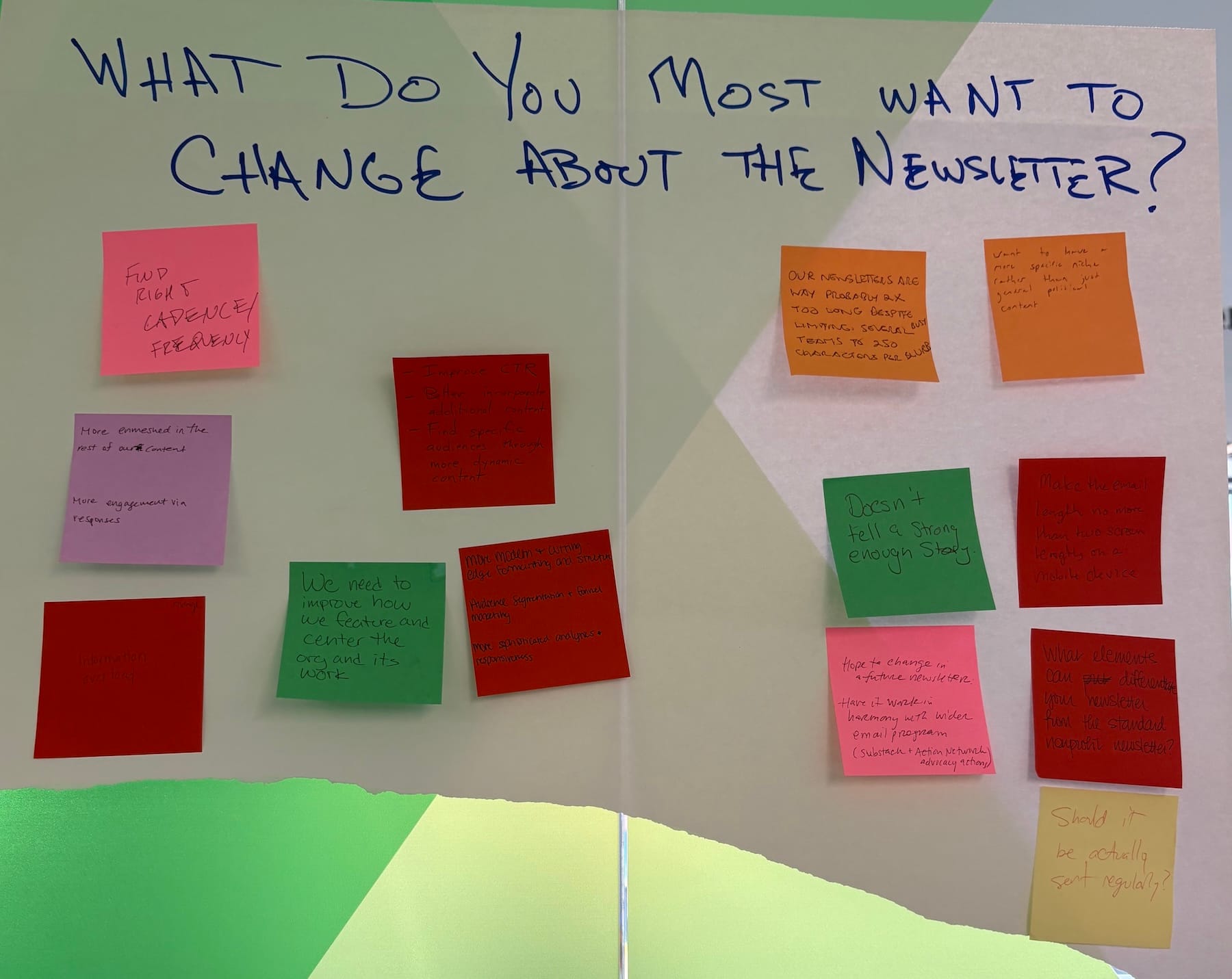
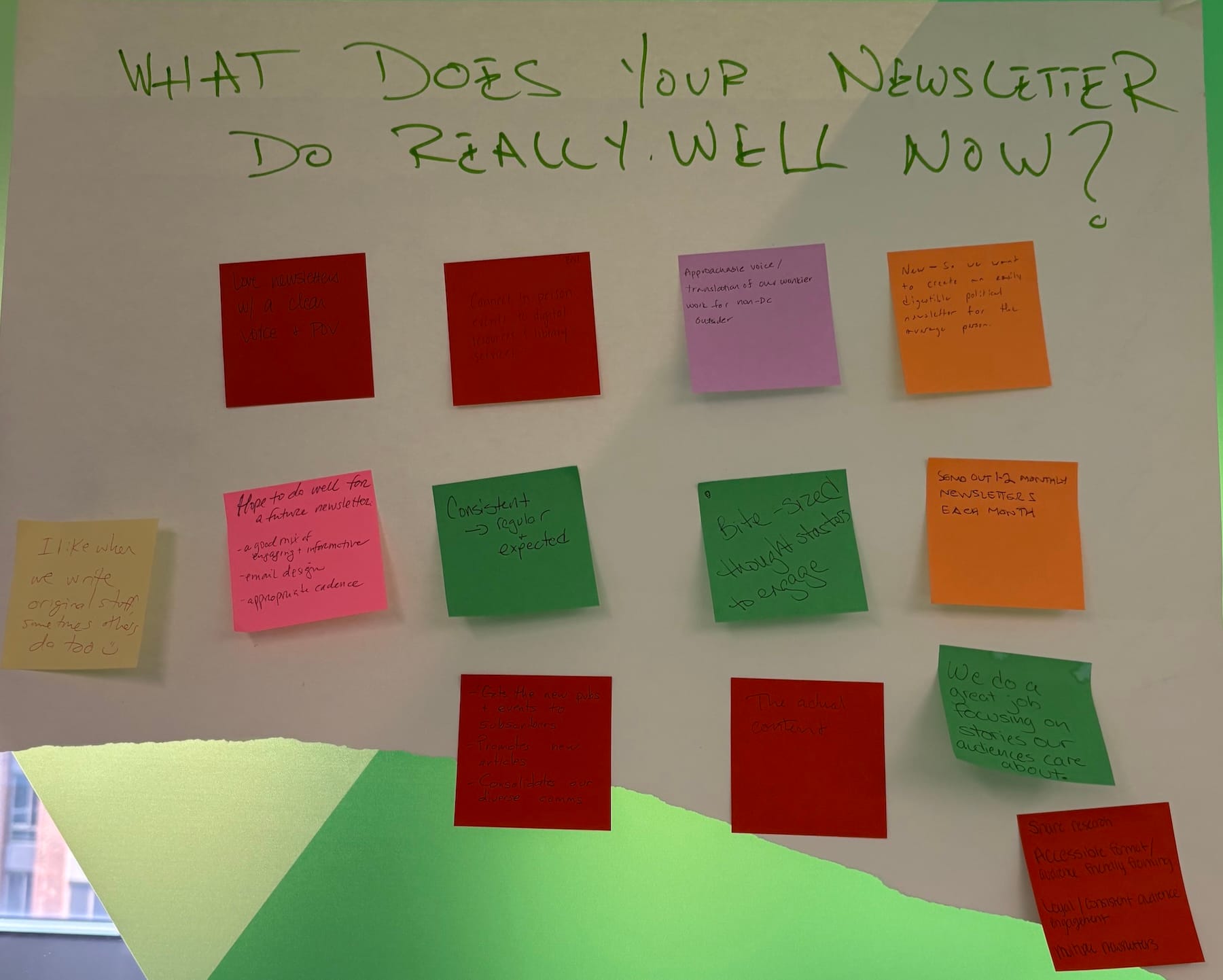
What does your newsletter do well? And what do you most want to change about it?
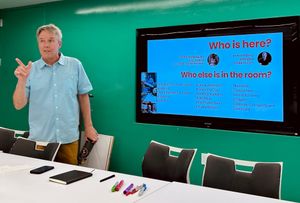
Those are the two questions we opened up with at last week's Newsletter Nerd Club in Washington, DC. We had just under 20 folks representing big and small nonprofit organization and a few communications and digital consultants in the room.
After the event I sorted the responses into top level categories and there's an interesting pattern: what these newsletters do well and most need to change are often the same things. Or at least most folks are thinking about the same issues:
- Content: many folks liked the content of their newsletter. Many others (and many of the same folks) really want to do better or other things with the content. In general, though, almost everyone mentioned content as a strength and/or weak spot.
- Cadence (or frequency): Most people have questions about how often they should be sending newsletters. A few are happy with the cadence. In general, most newsletter leads have questions about how often to send. I wonder if this signals questions about perceived value, goals, or audience engagement.
- Design and format: Like cadence, a few folks are happy with their design. Many more have concerns or wonder if and how it could be improved. These folks often questioned content as well.
A few folks wanted to work on segmentation. Are they segmenting enough? Are the segments the rights ones? How do you even know?
Overall, a couple things that stand out to me are the number of times questions about cadence came up. And how few folks mentioned audience as a strength or weakness.
These weren't all small groups running a generic newsletter sent to every subscriber off the side of their desk. Most are responsible for one or more themed newsletters with, one presumes, some clear goals and resources. Even then, newsletters can be forgotten stepchildren of the comms or digital program and the person running them can be on their own to figure it out.
Cadence (or how often to send) becomes a central concern and one that dictates how much time one can spend on the project. Meanwhile, audience - who the newsletter is for, why, and what the value is for them - gets mushy and hard to describe. A newsletter becomes a thing to do, not a product with intrinsic benefits to build or lose.
There are no rules. And I don't care what a consultant says, the best practices are things you already know.
There is no ideal newsletter cadence, length, or design. How often you send a newsletter can be varied, tested, and tracked. So don't be afraid to mix it up and throw an extra edition in there.
And the more questions you ask of your audience (or hoped for audience) and the more you really listen, the more you'll know about what people value, how and why they engage, and what they need from your content and newsletter. That's why best practices are things you already know–or can at least learn from listening (and not just from reading posts like this). Sit down and talk to people.
Welcome to Boot Camp
(or some thoughts on the email welcome series)
Maybe your email welcome series isn't for easing people into your list or organization. Maybe it's more like boot camp. You want to turn people into true believers with a bit of manic passion. And for those who don't get on board you want to make it easy for them to walk away. No hard feelings. Why? You need people who believe and don't have time or money for the ones who will never open, never read, never get involved.
Related to this, The Atlantic is sending emails asking subscribers if they'd like to leave. On one hand this is a simple re-engagement campaign. Something more groups should be doing. On the other hand it is The Atlantic saying that a non-paying subscriber who doesn't open emails isn't worth keeping on the list. Something more groups should be saying to themselves.
Yes, it's incumbent on you as the comms team or audience editor to run a strong program. But it's also okay to tell subscribers to get with the program or go away until you're ready.
Bright Ideas
Smart people with big ideas and a few great events...don't miss these.
1/ "Among other things, design is systematic optimism. You have to be optimistic to think you can make meaningful positive changes and additions to the world," writes designer Erika Hall in Stop Raising Awareness. Hall offers more insights on creating systems change than a couple dozen long reads in SSIR or a foundation think piece.
2/ My first (and hopefully not my last!) Charli XCX Bright Idea: Inc. has a story about Anti-Marketing after Charli XCX tweeted about the future of marketing being intimate, personal, and private. And not about mass reach and scale. That's easy to say when you're on top of the world, of course. But it also reflects a broad and growing antipathy towards mass social. A thousand (even 500) true believers who will take to the streets is worth so much more than a silent list of 100,000 email addresses.
3/ Remember MapQuest? 20-25 years ago it was THE online map company. Then it wasn't. Now, thanks to the demented renamer in chief, it's the most downloaded app on Google and Apple app stores. Ernie Smith offers a fresh look at the rise and fall and rise of MapQuest. I'll suggest this is a nod to the impermanence of tech companies. Not a one, not Google or Apple or Meta or Amazon, are essential or unable to fail.
4/ "If 'Pause, Reflect, and Organise' were a physical object I'd gleefully toss it from the highest peak and into a fiery pit where it belongs," is a comment I wrote on LinkedIn after reading a bit of drivel about reinventing oneself for the job market. Thanks (I guess?) to Rachel Happe for linking to the article in The Independent.
5/ How to Keep Organizers in the Movement is a conversation with immigration organizer Tania Hall in Convergence. Movements (and funders) that lose organizers are losing trust, power, time, and money. Talk to the organizers, not the executive directors or, worse yet, the consultants.
6/ What Gmail’s political sender program actually says about deliverability by Alison Gootee at Mailgun. TL;DR it's not up to Google to verify you or determine legality. But if people say your emails are spam then they're spam.
7/ Chant this at the start of your editorial meeting: A content calendar is not a content strategy. At Content Marketing Institute, Robert Rose writes about story budgets:
Put a story budget process upstream of it [the calendar]. Write the editorial line, name your coverage pillars, align with a point-of-view architecture, and make every idea earn a budget line by passing the three-part tension test. Then, let the calendar do the one thing a scoreboard is good at — showing the result.
Events and Training
- Going to Climate Week in NYC? I'm not. But if you want someone on site to develop stories and run content strategy then I'd love to hear from you!! Short of that, this Imagined Futures event from Sep 19 to 27 looks fascinating and fun. Get together with other good humans to explore ecological treasures and spark inspiring visions for the future.
- DC folks check out the Nonprofit Tech Connect, Speed Networking & Knowledge Sharing event on September 22nd. I'm totally down with the format of this in person event organized by Roshani Kothari and Brenna Holmes.
- Frank xPortland is October 15th at Portland's Ecotrust Building.
- Splice Beta: Fork It!, a space for space for creators, innovators, media entrepreneurs, is November 26-28 in Chiang Mai, Thailand.
Want to get your event or training out to the Future Community network? We're happy to share. Click reply and make sure we know about it.
Future Community Jobs
We send a big Future Community Jobs email on Tuesdays but here are a few very recent highlights. Remember, the full Future Community job list is always on and updated.
- Director, Program Influence (Communications & Advocacy), Health : The Rockefeller Foundation [New York City]
- Senior Program Manager, Product Technology : Patagonia [Ventura, CA]
- Data and Analytics Director : The Wilderness Society [Remote in the US] ⏱️ September 20
- Development Director : Colorado Mountain Club [Golden, CO]
- Director of Audience Engagement and Community Outreach : The Maine Monitor [Remote in Maine] ⏱️ September 15

Ted here. I run Bright+3 where we give changemakers the ideas, inspiration, and tools to create content that builds stronger communities. I also write this newsletter (aka Future Community) and run the Future Community Jobs list.
Below is the closing stanza of Wendell Berry's 1962 poem The Habit of Waking. Perhaps you can get a whiff of the damp grass and maybe, if you close your eyes and listen, really listen, you can hear the ruddy croaking of frogs in the distance.
And in the selfsame dark
the creeks, in the aftermath
of the first heavy rains,
are audible to the hilltop
—the wash of sound entering
the consciousness of walls.
Among the soaked grasses
along the down-meaning streams
in the weather of engines
the old singing of the frogs
begins. The dark breeds
dawn, a deeper melting.
Read the full poem. Berry passed away on August 31, 2026, at the age of 92. His 1977 book, The Unsettling of America: Culture & Agriculture, remains one of the most clearly stated and prescient articulations of how industrial agriculture pits humans and the Earth against one another.