

Hi Mary, Eira, and all of you joining us at Future Community.
📢 I'm running a Newsletter Nerd Club workshop on October 7th and I'd love for you to join us.
This is a 90 minute workshop built to take take you from newsletter idea to newsletter product. We'll cover goals, audience, content creation, cadence, staffing (even if it's a staff of one), the tech needed and more.
This is a working session. We will get work done! So space are limited. Find out more and save your spot here. I hope you'll join us.
This is a paid workshop. Please reach out if you want to participate but cost is an issue.
Hurry up if you're into this one: End Citizens United is looking for a full-time Deputy Legislative Director to be based in Washington, DC. This person will be working with partners in DC, state capitols, and coalitions to support anti-corruption reforms and fight big money in politics. Salary listed is $81,000 – $115,000.
How do we connect with a person?
Our sector's responses to the changes AI is bringing are predictably tactical:
- Figure out how to change everything we do to meet the tech requirements.
- Figure out how to use the tech to be more efficient, to optimize, to personalize.
Email, websites, social media, texting, mobile phones. All came along and nobody in nonprofits questioned how reshaping our communications and organizing for digital would change how supporters relate to, trust, and care for our organizations. We could still communicate and "connect" with all our supporters. And now we could reach infinitely more people. What power.
Of course, we simply don't have the time, budgetary freedom, or risk aversion to step back and ask whether the underlying supporter and fundraising model we're trying to scale makes sense.
Over on LinkedIn last week I shared a story and chart from Axios. Together they show data gathered by SimilarWeb documenting a huge (about 33%) drop in search traffic to major news sites over the past 24-ish months.
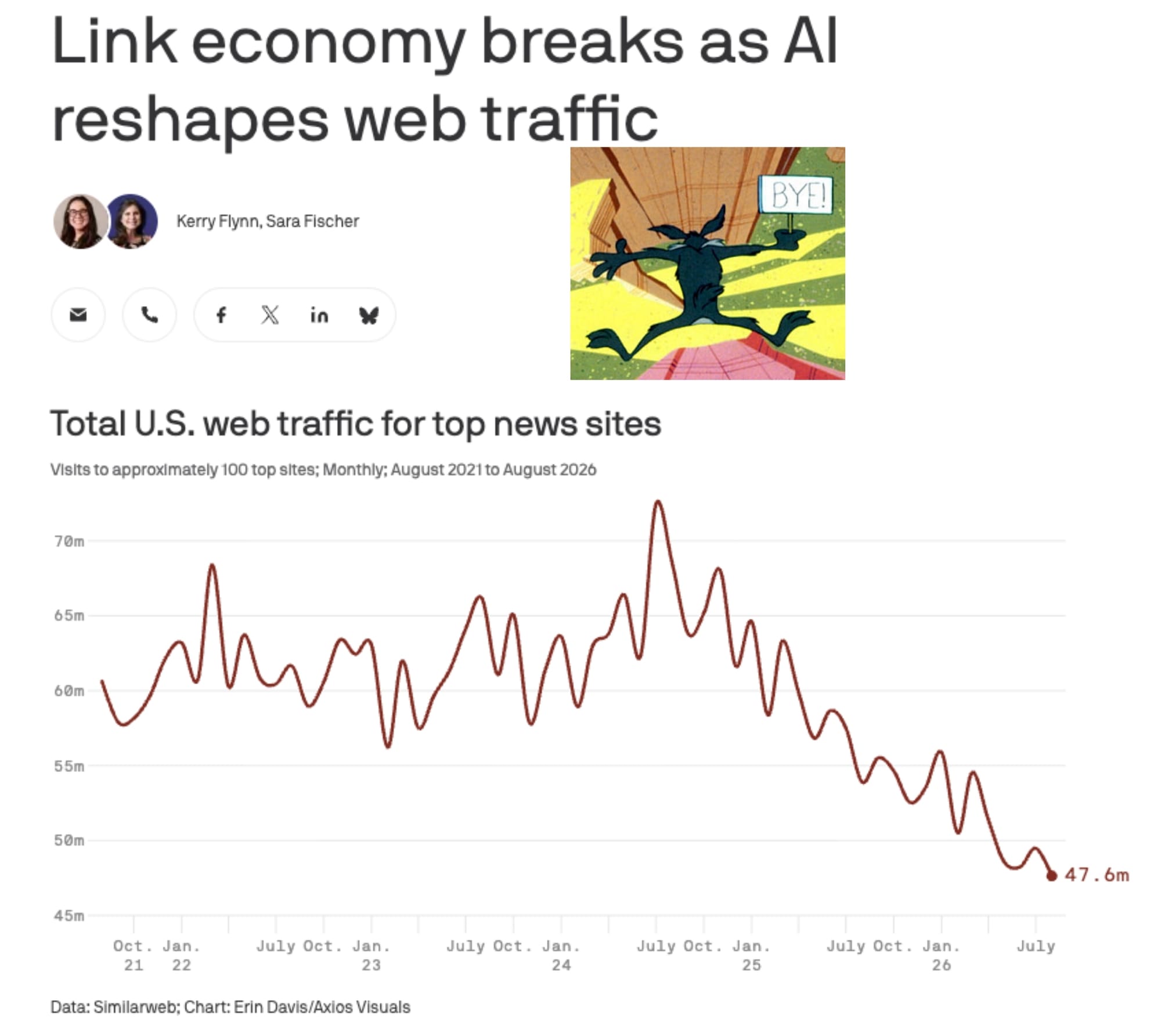
This traffic shift is also happening across the nonprofit sector. This has people concerned about their ability to attract visitors who become donors. It's also leading to more paid advertising and conversations about how to optimize content for AI search. These responses miss the point.
On one hand, what AI search is asking of our content is something we should have been doing all along. We should create content that answers questions, solves problems, and delivers value to users.
On the other hand, we should be doing all that only if we believe in the strategic principles of community and trust. And not just strategic marketing–because AI search is a loser's game.
People use AI search to be given an answer. They don't want a list of links. And AI search providers prefer to keep the user on their site or in their app.
We're still asking the wrong question
Since nonprofit email became a thing in the mid to late-1990s andsocial media around 2010 (and really since direct mail took off in the 1970s) we've asked "How do we use this channel to connect with more people?"
Success is just a numbers game. Right?
Maybe the question to ask is simply "How do we connect with a person?" Or is that too naive? Too basic?
I imagine the realists will say we should use AI to personalize content and deepen our connection to people. But I can't help but wonder about how digging a technocratic hole ever deeper is going to solve the problem of connection. Sam Altman and Mark Zuckerberg would have us believe that AI products will provide companionship, comfort, and control over our lonely and miserable lives.
Most people, however, are coming to the conclusion that more (and more) tech is the source of the problem, not the solution. These are two recent pieces that, along with an awful lot of polling data, capture the current sentiment towards tech intermediaries:
- 71% of Americans Say They're Completely Exhausted by Ed Cara in Gizmodo
- What if We Just Stopped? by Dan Sinker
It's not just me (or you?) who is tired of being gamed and optimized (or trying to figure out how to game or optimize).
Great, you say. So what comes next. Some starters:
- Extreme focus on list retention.
- Extreme attention to what different kinds of people want and need in order to participate, not just subscribe.
- Visibility on the ground, in the community, at events.
- Taking a hard look at email lists and social media followers to focus on what's working, what's not, and how to fix or improve both.
- Volunteering as a core part of the member experience, not a nuisance add on.
- Communications grounded in community interests and needs, not just list conversions.
This isn't about "AI Good" or "AI Bad." I have powerfully conflicted thoughts on that debate. And it's the wrong conversation right now. The path to sustainability and power (and even cultural relevance) is through people's emotions, ideas, and trust. Not their data points in a CRM or marketing file.
Bright Ideas ☀️
Smart people. Big questions. Maybe even a few solutions.
1/ Good question: In Why is everyone in tech so sad?, Aaron Horwath suggests that AI may finally expose the lie that most everything knowledge workers do is performative busy work of little direct value to anyone. Is that unsettling? Yes. Could that encourage people to do more meaningful work? Perhaps.
2/ How do you build and support strong networks? 20 Behaviors for Strong Network Culture and “Net Effects” by Curtis Ogden at Interaction Institute for Social Change.
3/ Alexandra Alter has a wonderful profile of Carol Gilligan who, at almost 90 years old, is researching how and why girls silence themselves to avoid conflict and why patriarchal beliefs remain entrenched, despite decades of resistance.
#/ ‘We're Screwed.’ 270 TV News Insiders Just Told Me the Truth. Broadcast journalist Josh Helmuth surveyed TV news people to measure the pulse of the industry.
4/ For those who enjoy weird fantasy/sci-fi or are using speculative fiction and futures in your work: Weirding the Periphery: How Imperialism Infiltrated Our Imagination Through Fantasy by Eden Kupermintz in Typebar.
5/ There are countless reasons people fight data center development. Environmental impact, noise, and energy affordability are a few. But the issues, always open for debate, overcomplicate what's happening.
This is one of the few sentences I've seen that clearly states why Americans are so broadly (and vociferously) opposed to data centers.
...amid a rising sense of precarity and disinvestment, communities see data center resistance as a means for resisting the larger, remote systems of power that structure their lives.
Read more in Data & Society's new report The AI Factory: Data Centers, Power, and Resistance in Late Industrial Pennsylvania.
6/ Speaking of AI: Some, or at least Nan Ransohoff, have suggested that a wave of wealth AI workers will deliver a third wave of philanthropy. Jennifer Thuy Vi Nguyen prefers to aspirationally suggest instead a Third Act of American Philanthropy.
I agree with Nguyen's statement: "We must widely reject the idea that wealth-driven institutional philanthropy is an appropriate response to economic inequality and the right vehicle for increasing public good."
But I wonder how relevant philanthropy will be as more and more private wealth moves through DAFs and other instruments built to elude any sort of shared collective benefit or value.
7/ Can Democracy Survive a Culture of Cruelty? asks Professor Danielle Allen. It's shocking that we even need to ask this but here we are. It's also incumbent on nonprofits and civil society to take seriously their power to nourish thriving communities through care, connection, trust, and story.
Events and Training
- The Pulitzer Center is accepting applications for the Climate Storytelling Accelerator. The deadline is October 9th.
Want to get your event or training out to the Future Community network? We're happy to share. Click reply and make sure we know about it.
Future Community Jobs
Visit the Future Community job list, it's always on and updated.

Hi. I'm Ted Fickes. I run Bright+3 where we help teams in progressive spaces create content and stories that build community so that organizations turn supporters into leaders. I also write Future Community (this newsletter) and run Future Community Jobs.