

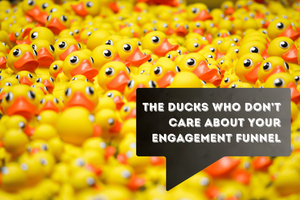
In The Place of Tides author James Rebanks tells the story of living on a small island off the coast of Norway for three months. He's there to help Anna Måsøy support a colony of nesting eider ducks. Anna is a 60-something woman who grew up around the coastal archipelago anchored by the large(ish) island of Vega where she lives and raised four children.
According to Rebanks he's also there to escape the chaos and uncertainty of his own life. Perhaps it's a mid-life crisis, he thinks.
Rebanks casts Anna as a potential hero or at least a role model. Here is a woman who has purposefully chosen to escape to an island where there's only wind and ducks. There's no power. No television. No internet. Certainly no traffic. Hardly another human.
The only schedule is set by the eider ducks who may or may not come ashore to nest. And they'll do it when they please, thank you very much.
Anna's story seems to be one of choosing to escape her community, neighbors, and family. Building nests, warding off predators, and caring for the ducks is both noble and personal. It is a sacrifice of sorts. It's a sacrifice, Rebanks thinks, that's done for herself. It's a sort of retreat. It's a mid-coast Norwegian woman's version of a budget yoga retreat, perhaps: self care through escape and silence.
Over time - and, yes, it takes time - Rebanks talks to Anna and listens to her stories. He also learns about the work it takes to return to the island each Spring, restore nests, wait for ducks, remain silent for weeks while they nest, and then collect and clean eider duck down. These are the feathers ducks use to soften and insulate their nests. It's a precious commodity though a season's worth of 150 nests may net one only enough down for a single comforter. This isn't a high wage industry.
We begin to see that Anna is doing this work for the ducks, too. It's also a way of giving back to her family and their history. It's Anna making an offering to her community and generations of Norwegians who came before and will come after her.
Anna is, in her way, one of the most selfless and committed community activists you'll meet. I suspect she would never agree with that assessment nor would she feel at all radical.
Humans have become essential to the eider duck nesting cycle because decades ago Norwegians introduced mink and other predators the islands. Added to the populations of native eagles, coming ashore to nest became a dire proposition. A duck species needs a nest to survive. A single duck is no match for a population of minks or otters.
Anna spent years restoring nests. Slowly she earned the trust of eider ducks. The ducks gradually returned to her island.
Humans are also the greatest threat to the ducks. Overfishing and warming seas means fewer fish. That means fewer ducks.
Action doesn't NEED you and your organization
Work to sustain and support the future of communities often appears to be solitary. People do it without reward or compensation. Often, like Anna, they can't put their extraordinary care for nature, community, or ducks into words. And they can't really explain why they give up so much for the work.
Advocacy, community engagement, donating, are volunteering are all highly analyzed and scrutinized acts in a world of data, CRMs, pixel tracking, and AI-assisted advertising placement. We optimize our forms and test our messages to improve conversion and push some percentage of our audience further along the funnel.
Along the way we discover that most people on our lists never seem to open an email. We slowly (or quickly) move on from them and focus on the "engaged" subscriber. It is, after all, a funnel. A funnel narrows and narrows until only the BEST get through. Most people won't make it through your funnel.
Spoiler alert: most people don't care about your funnel. Neither do the eider ducks.
What's outside the funnel?
A friend once tried to describe an "engagement swimming pool" to a room full of organizers and digital campaigners. His point being that everyone was swimming or doing something in or around the pool. Everyone's actions had meaning to them. But some were in the deep end. Some were underwater. Some were sitting on the edge.
But everyone is engaged. At all times.
What if a lot of community, cultural, and social change we intend to create or catalyze is out there happening through actions we can't observe, measure, design for, and monetize?
Of course, the change most of us want, need, and are working towards is not happening. Just look around. Perhaps we need a bigger funnel.
Or we need to be living, watching, learning, organizing outside the funnel. For every Anna Måsøy there are 1,000 people quietly showing up to staff local school and mutual aid actions, pick up trash along the creek, and count birds and talk to their neighbors about what they see.
Too many organizations have been told you can't do what you can't measure. Email lists that were intended to grow and strengthen the fabric of community have instead become transactional data points to churn through.
Across the nonprofit sector you'll hear about how AI will improve targeting and segmentation. We'll create more efficient and personalized messaging. When do we stop and consider that optimizing transactions and persuasion isn't what people wanting change need?
You may need to get out of the office, talk to people, and create projects people can do in the time they have...projects that create results they can see, use, and apply in a life that is busier, more stressful, and increasingly uncertain. Ask, listen, acknowledge, appreciate. These are going to be most powerful next steps.

top photo by Andrew Wulf via Unsplash